
Skip to content
LyfeGoBusiness

Applied Sport

Sport as the medium for serious games.

Applied Sport uses sport as the medium for serious games and experiential learning: experience before abstraction, observable behaviour, structured reflection and workplace transfer.

Instead of choosing a sport first and adding a debrief afterwards, we begin with what a team needs to experience, practise or understand. Then we design the game around it.

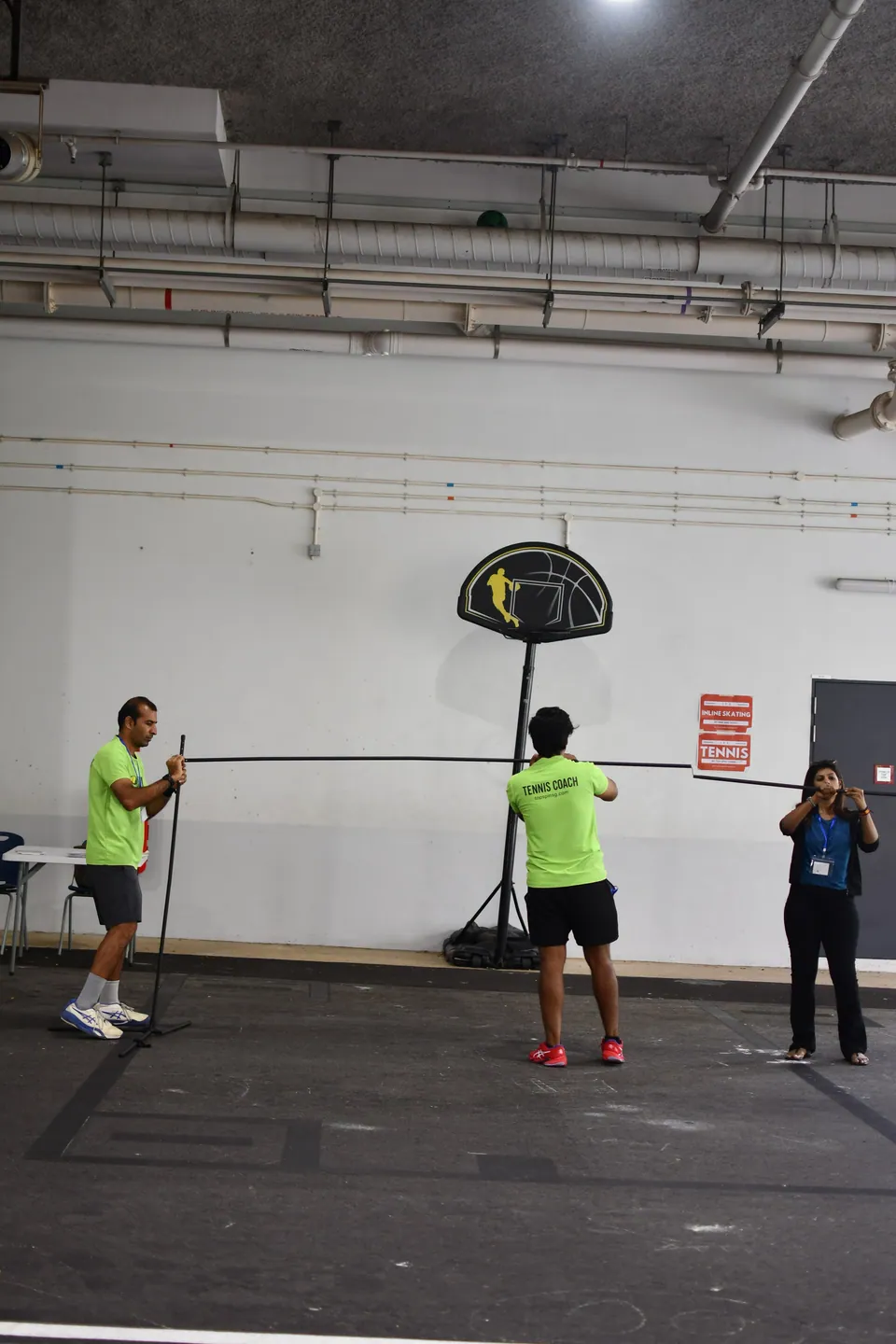
Coaches positioning the frame of an indoor activity station

What makes a game serious?

A serious game has a purpose beyond entertainment, such as learning, practising decisions or developing skills. It can still be enjoyable. Enjoyment is simply not the only objective.

The learning objective should shape the game itself. Communication must affect what happens. Adaptability needs changing conditions. Leadership needs meaningful decisions, not just someone wearing a captain’s armband. Read the design foundations.

We use sport as the medium

The starting question shifts from “What should we play?” to “What should this team experience?” LyfeGo can modify rules, roles, goals, information, resources, team composition, scoring, time and communication channels. Each major choice should serve the intended objective.

The activity is not followed by the learning. The activity is part of the learning.

Applied Sport is LyfeGo’s application of serious-game principles through sport. It is our design methodology, not an independently validated academic category.

The difference is why and how it is designed.

Recreational sport
Enjoyment, participation, competition or wellbeing.
Sports-based team bonding
Connection and a shared experience.
Applied Sport
A defined learning, behavioural or organisational objective that shapes the game and reflection.

None is inherently better. A recreational session may be exactly what your team needs. Applied Sport is relevant when there is a specific capability to practise.

One game. Different purposes.

Captain’s Ball can be played simply for enjoyment, or adapted around a development objective. These are illustrative design choices, not six separate products.

Recreational play
Score more points than the other team. Enjoyment and participation are enough.
Communication
Give players different information that they need to share to coordinate effectively.
Leadership
Rotate leadership responsibility between rounds and review how others were involved.
Adaptability
Change a scoring condition and ask the team to reconsider its approach.
Cross-functional working
Give subgroups control of different resources needed for the collective target.
Behavioural awareness
Use observations and reflection to explore different approaches to planning, decisions and pressure. Do not infer a fixed personality from play.

Simulating the conditions teams work in

We do not turn a badminton court into an office. We identify important behavioural demands at work and recreate simplified versions through game mechanics.

Tight deadlines
In the game: Compressed timePractise: Agree priorities before acting.
Incomplete information
In the game: Different instructions for different playersPractise: Surface what others do not know.
Resource constraints
In the game: Limited equipment or attemptsPractise: Decide where resources matter most.
Changing priorities
In the game: Scoring conditions change between roundsPractise: Review the plan instead of repeating it.
Cross-functional dependencies
In the game: One group’s progress depends on anotherPractise: Coordinate handovers, not just individual tasks.
Individual and collective KPIs
In the game: Individual points can conflict with the team targetPractise: Discuss trade-offs and shared success.
Influence without authority
In the game: Critical information sits with a non-leaderPractise: Invite expertise regardless of role.

What could your team practise?

Explore illustrative applications. These are design examples, not client case studies.

Sales teams

Ambitious targets, limited opportunities and pressure to deliver individually without losing sight of the team.

Possible design: A scoring challenge has an ambitious collective target. Opportunities carry different values and attempts are limited. New information arrives during play. Reaching the target requires participants to share information and allocate opportunities, not simply maximise their own points.

Questions to explore: Did the target change how we communicated? When we fell behind, did we become more strategic or more reactive? Did individual goals help or hinder the team?

Operations teams

Sequencing, bottlenecks, handovers and the trade-off between speed and accuracy.

Possible design: An interdependent relay uses limited shared equipment. Each station relies on the previous group’s handover. A resource or rule changes midway. Moving faster can create rework if teams ignore the wider flow.

Questions to explore: Where was the bottleneck? Did we improve our own station or the whole system? When did speed reduce accuracy?

Leadership teams

Ambiguity, distributed expertise and leading through others.

Possible design: Participants receive different pieces of information. The designated leader cannot solve the challenge alone. Responsibility moves between rounds, giving the group a reason to separate authority from expertise.

Questions to explore: Who influenced the direction? What information stayed hidden? How did leaders invite challenge, and what changed when authority moved?

Cross-functional teams

Different local objectives within an interdependent system.

Possible design: Subgroups control different resources and have their own targets. The whole team succeeds only when resources and information move across boundaries.

Questions to explore: When did our local target conflict with shared success? What made a handover useful to the next group?

New or newly formed teams

Unfamiliar colleagues, emerging roles and working norms that have not yet been agreed.

Possible design: The group forms a plan, encounters competing approaches, agrees how to coordinate and tests those agreements in another round. Tuckman’s model helps frame the conversation, without assuming everyone moves through the same stages in order.

Questions to explore: How did we handle disagreement? Whose view went unheard? Which working agreement helped in the next round?

Teams practising shared leadership

Taking initiative, learning from feedback and influencing without formal authority.

Possible design: Rotate responsibility for planning, briefing and coordinating. Give each participant opportunities to lead and support, then practise a different approach after feedback.

Questions to explore: How did we gain support without a title? What made it easier to speak up? What will we try when communicating with a senior colleague?

From objective to workplace practice

  1. Define
  2. Design
  3. Experience
  4. Reflect
  5. Re-play
  6. Transfer

Agree the behaviours that matter. Build them into the game. Observe what happens, reflect, then test a different approach. Finish with a practical workplace experiment, not just a conversation.

What could this look like?

An illustrative programme for a fast-growing team struggling to coordinate under pressure. A planned disruption sits within the experience, rather than adding another required stage to every programme.

  1. 1.Define

    A fast-growing team needs to coordinate under pressure. Agree the behaviours to practise: clarify priorities and roles, surface information, manage handovers and adapt.

  2. 2.Design

    Create a multi-stage sporting challenge with a demanding time target, different responsibilities, limited shared equipment and incomplete information.

  3. 3.Experience

    The team attempts the challenge. Facilitators observe specific moments of communication, decision-making and coordination, rather than rating personalities.

  4. 4.Disruption

    Introduce a planned change within the agreed safety boundaries: reduce the available time, change a role or release new information. Observe how the team responds.

  5. 5.Debrief

    Ask what happened before interpreting it. Where did coordination break down? What information was available but unused? Where does something similar happen at work?

  6. 6.Re-play

    Choose a new behaviour, such as confirming the next station is ready before handing over. Test it in a second round and compare what changed.

  7. 7.Transfer

    Translate the experiment into work: name a decision owner, agree a handover check or surface concerns earlier. Decide who will try it, when and how the team will review it.

A structure for experience, reflection and another attempt

LyfeGo draws on established learning and sport-psychology frameworks. Each has a different job. The programme design and examples here are our application of those ideas.

Kolb’s experiential learning cycle

  1. Experience
  2. Reflect
  3. Learn
  4. Re-play

Act in a challenge, review what happened, identify a principle, then deliberately try a different behaviour. “Learn” translates abstract conceptualisation; “Re-play” puts active experimentation into practice. A second attempt is part of the learning, not a reward at the end.

Experiential learning foundations

Tuckman’s team development model

  1. Form
  2. Storm
  3. Norm
  4. Perform

A team starts with roles and an initial plan, encounters different approaches, agrees working norms and tries them towards a shared goal. Teams can revisit these dynamics. Short rounds offer opportunities to practise coordination; they do not permanently move a team through a fixed sequence.

Tuckman’s original model

Teamwork in sport

Preparation, execution, evaluation and adjustment provide a useful rhythm. Agree roles and strategy, coordinate while playing, examine what happened and change the next attempt. A pass, a handover or a missed target gives immediate feedback to discuss. It does not by itself tell us what someone will do at work.

McEwan and Beauchamp’s teamwork framework

Process goals

An outcome goal might be winning. A performance goal might be ten successful passes. A process goal is an action to practise, such as confirming a teammate is ready before passing. We review the behaviour as well as the scoreboard, then agree its workplace equivalent.

Research on goal-setting in sport

Challenge and threat

Pressure is experienced differently depending on the demands people perceive and the resources they believe they have. For high-pressure teams, we consider preparation, support and perceived control alongside the challenge. More pressure is not automatically more useful, and facilitators do not diagnose a psychological state from performance.

Challenge-and-threat theory

Notice the behaviour. Do not label the person.

The same game can feel different to different people. One acts quickly; another seeks more information. One takes control; another contributes through observation. The useful question is what happened in this context, not what fixed personality it proves.

Where appropriate, APEX DiSC® provides another lens for reflection. Participants can compare how they describe themselves, how colleagues experience them and what they noticed during play. Observations are additional material for discussion, not a personality diagnosis or a clinical assessment.

Facilitation connects the experience to learning

Start with “What happened?” before “What does this tell us?” Facilitators observe specific moments, invite different perspectives and ask participants what they noticed. They help the group test interpretations, connect relevant concepts to work and choose a behavioural experiment. Observers can track agreed behaviours, such as who asks for information or checks a handover. The facilitator does not impose a hidden meaning on every action.

Designed around the people taking part

Participants do not need to be athletes. Unless sporting performance is itself the objective, athletic ability should not decide who can contribute.

We can simplify rules, lower physical intensity, vary equipment, introduce cooperative goals and create different roles. Planning considers fitness, confidence, age, accessibility, injuries, venue, group size and the objective. Not every sport is suitable for every participant.

A starting point for reflection, not a diagnosis

Applied Sport creates a shared environment in which behaviours can emerge, be examined and be practised. It does not establish someone’s personality, predict their workplace behaviour or guarantee lasting cultural change. Transfer depends on what happens afterwards, including leadership support and working conditions. Where the need is unclear, a Training Needs Analysis may be appropriate before choosing a programme.

One methodology. Different programme applications.

Applied Sport explains how the learning experience is designed. The programme determines who it is for, what to practise and the level of facilitation needed.

Communication, change and adaptability can be design objectives within these programmes. They are not additional packages, and recreational events do not need to become development workshops.

The thinking behind the design

These sources inform our approach. They do not validate Applied Sport as a complete methodology or establish outcomes for LyfeGo programmes. Our sporting examples are illustrative adaptations, not replications of the studies.

Explore the research and frameworks
  • Serious-game design

    Arnab and colleagues: Mapping learning and game mechanics for serious games analysis (2015). Research on connecting learning design with game mechanics, not validation of Applied Sport.

  • Experiential learning

    Kolb, Boyatzis and Mainemelis: Experiential Learning Theory: Previous Research and New Directions (2001).

  • Team development

    Tuckman: Developmental sequence in small groups (1965). A proposed model, not a guarantee of linear team progress.

  • Teamwork in sport

    McEwan and Beauchamp: Teamwork in sport: a theoretical and integrative review (2014).

  • Goal-setting

    Williamson and colleagues: The performance and psychological effects of goal setting in sport: a systematic review and meta-analysis (published online 2022). Sport findings should not be treated as guaranteed workplace effects.

  • Challenge and threat

    Meijen and colleagues: A Theory of Challenge and Threat States in Athletes: A Revised Conceptualization (2020).

What should your team experience?

Tell us what your team is trying to improve. We can design the sporting environment around it, through experiential team building and corporate training in Singapore.