
By Luke Phang
Published
Low participation needs a diagnosis
An empty session does not tell you why employees stayed away. Some may be uninterested; others may have wanted to attend but could not leave work, reach the venue or understand the invitation. Ask before interpreting absence as indifference.
AIA Singapore’s 2025 Corporate Wellness Study reported low awareness of many workplace wellness programmes, with fewer than 30% of employees aware of their existence. It also reported that participation tended to be higher and more frequent when employees were aware. These are survey findings, not a universal attendance rate or proof that extra reminders alone will solve low participation.
The study surveyed 400 employees and 125 business decision-makers in July 2025. It also reported that most companies spent below S$200 per employee per event and one in four had increased or planned to increase wellness budgets. Use these findings as context, then investigate your own workforce.
What low attendance does to a fixed budget
Consider an illustrative event with a fixed committed cost of S$15,000 and 100 intended participants. The planned cost is S$150 per person. If 30 people attend and the cost remains S$15,000, the actual cost is S$500 per attendee.
That calculation is cost per attendee, not financial ROI. It assumes the full cost remains payable despite lower turnout. Where spending changes with attendance or refunds apply, use the actual final cost. Track internal planning time separately rather than inventing a salary-based saving.
The calculation helps HR see unused capacity. It does not show whether the people who attended benefited, so review relevance and experience alongside the numbers.
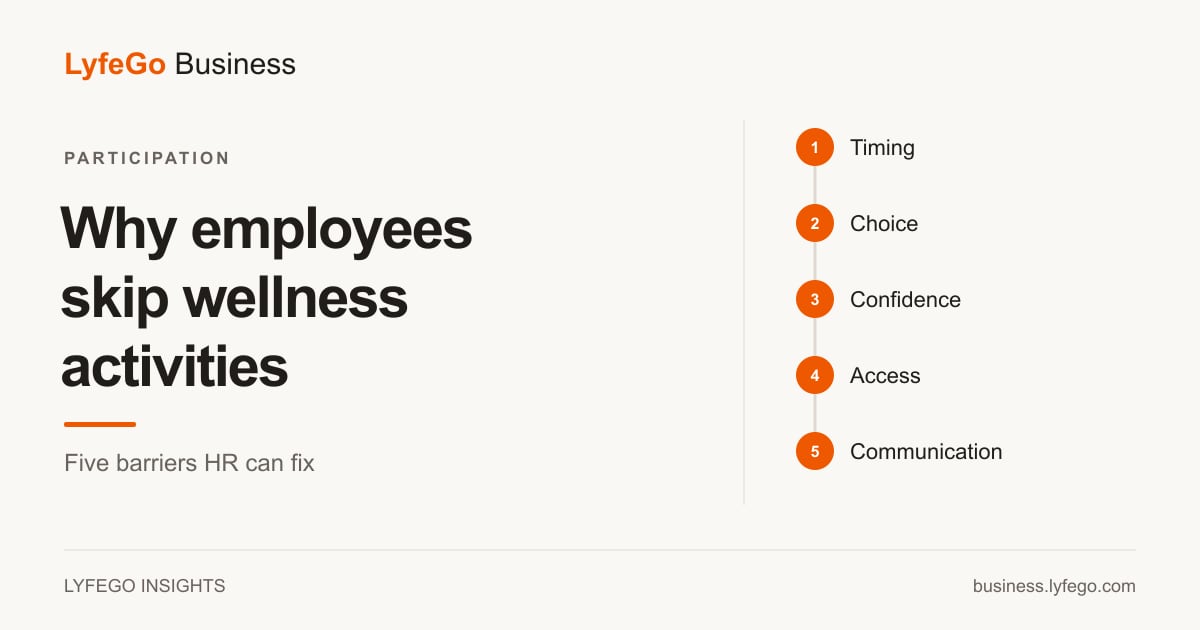
1. Timing conflicts with work or personal commitments
What happens: employees register but withdraw when meetings, deadlines or customer work intervene. Others never register because the session falls outside a workable time window.
What to check: compare registrations with attendance, ask which time windows are practical and check whether managers have actually made participation time available. An after-work slot may be difficult for people with caring responsibilities or a long journey home.
What HR can change: test another time, repeat a session for different shifts or arrange agreed work cover. Move beyond a general message that employees are encouraged to attend. Record what changed and compare attendance over equivalent periods.
2. The activity mix misses employee interests
What happens: the same small group joins every session while the rest of the workforce rarely appears. The calendar may reflect organiser preferences more than employee demand.
What to check: ask both participants and non-participants what they would choose. Compare interest in learning a sport, social movement, individual activity and lower-movement options. Avoid inferring preferences from age or job title.
What HR can change: test a small number of alternatives and describe each format clearly. The workplace wellness ideas guide offers 12 starting points. Do not add variety without checking capacity and scheduling; a longer list can still leave employees without a practical option.
3. People do not feel comfortable joining
What happens: a beginner assumes everyone else is experienced, or someone worries about being watched, making mistakes or joining without knowing anyone.
What to check: review the invitation, arrival process and first few minutes of the session. Does the description explain the level? Is there guided practice? Can a person arrive alone and receive a welcome? Is there a reasonable option to pause?
What HR can change: make beginner instruction explicit, brief the host on welcoming new attendees and use suitable lower-pressure formats. Ask privately about access requirements and confirm what can be accommodated. The goal is to remove avoidable barriers, not promise that every activity suits everyone.
4. The location or registration process creates friction
What happens: an appealing activity takes too long to reach, requires unexpected preparation or is difficult to book. A convenient venue for one office may be inconvenient for another.
What to check: walk through the entire journey from invitation to arrival. Include travel, changing time, transport costs, equipment requirements, registration steps and cancellation instructions. In Singapore, outdoor conditions and weather alternatives also need consideration.
What HR can change: trial a closer venue, a workplace session or different location options where feasible. Simplify registration and communicate practical requirements before people commit. If recurring booking and eligibility rules are becoming hard to manage, review the wellness portal versus ad-hoc activities guide before selecting technology.
5. Communication leaves basic questions unanswered
What happens: employees receive a general wellness announcement but cannot tell whether a particular session is relevant or how to join.
What to check: ask someone outside the organising team to read the invitation. Can they find the activity, level, duration, location, requirements, registration link and contact person? Are communications reaching employees who do not regularly check office email?
What HR can change: publish one clear session listing and use relevant channels and reminders. Explain what guests will experience, including any competitive or physical demands. Our wellness week planning guide includes an adaptable announcement and preparation checklist.
Track the point where people drop out
- Awareness: use a short question to find out whether employees knew about the programme. Email delivery alone does not establish awareness.
- Registration: record sign-ups by activity and time slot, including waiting lists where relevant.
- Attendance: count who actually joined and compare this with registrations.
- Reach: count unique attendees as a proportion of the defined eligible workforce over a stated period.
- Repeat participation: decide whether this means attending twice in the month or returning in a later period, then apply the definition consistently.
- Relevance: ask participants and non-participants what helped or prevented attendance and what they would choose next.
Choose the most plausible barrier, change a manageable part of the programme and review the result. For example, test a repeated session time before replacing an activity that employees already want. Changes in attendance are useful evidence for planning, but do not by themselves establish a causal business benefit.
When does external support make sense?
An internal programme can work well when the team has time, suitable providers and clear responsibilities. Consider external support when recurring bookings, varied locations, activity design and live coordination exceed that capacity. Ask what the provider will do and what your organisation still needs to handle.
LyfeGo’s Employee Wellness Programme starts with employee interests, practical barriers and an agreed participation baseline. Activities and supporting arrangements are coordinated within the agreed scope. The initial 90-day activation cycle provides a period to learn and adjust within a longer-term programme; it is not a guarantee of a particular participation increase.
Does low participation mean employees do not value wellness?
No. Attendance alone cannot distinguish lack of interest from lack of time, access or suitable options. Ask employees and compare what they say with the registration and attendance pattern.
Should HR make attendance compulsory?
Compulsory attendance can increase the headcount without showing that employees found the programme relevant. Keep participation voluntary, explain the options and make time and access practical. Do not treat attendance as a performance measure.
Will a platform or an external provider solve participation?
Neither does so automatically. Both may help with specific operational barriers, but programme relevance, workplace support and the actual employee experience still matter. Agree responsibilities and useful measures before committing.
A LyfeGo viewpoint informed by programme design and delivery experience.